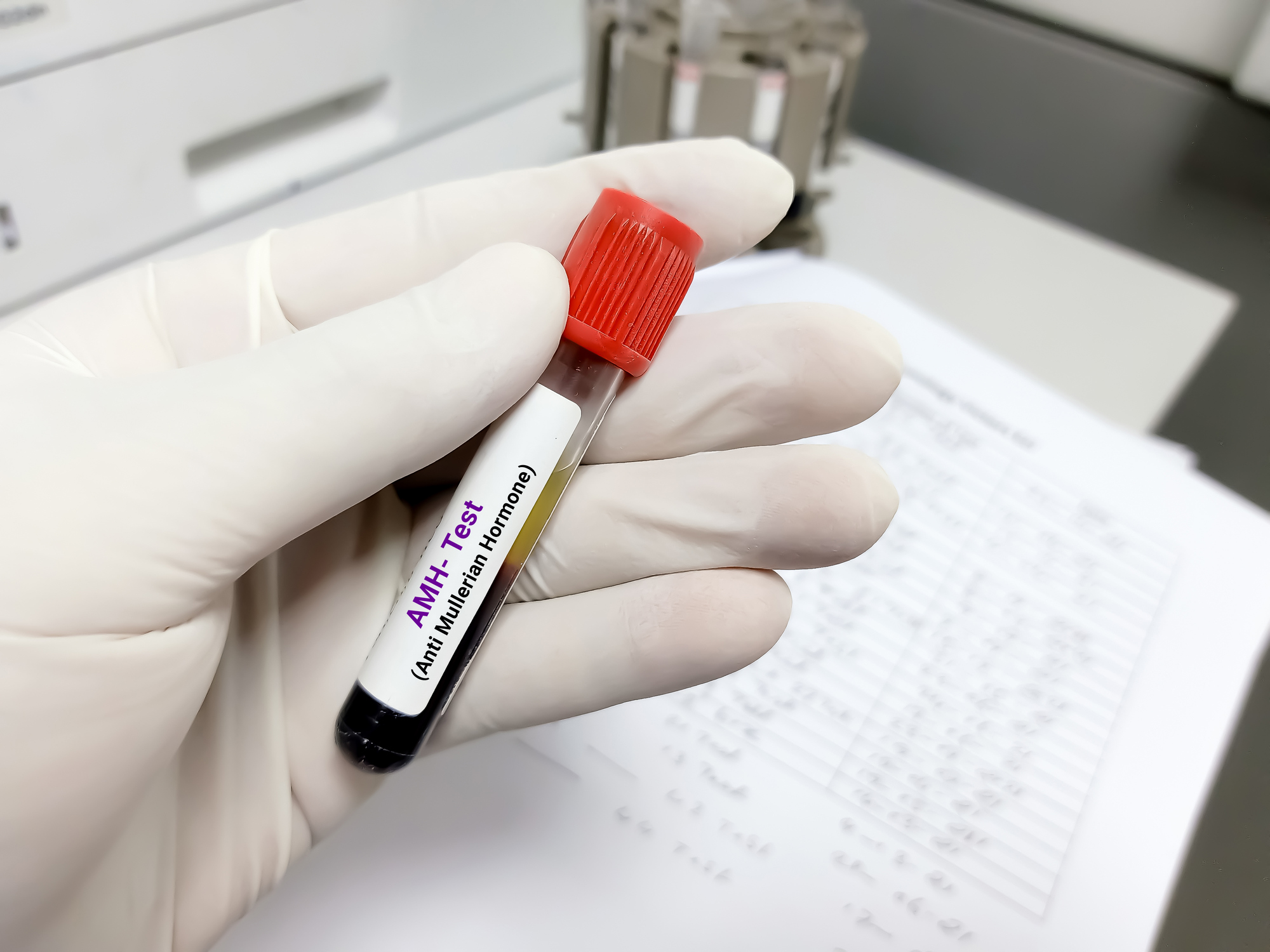

What is ovarian reserve testing?
Ovarian reserve testing estimates how many eggs remain in your ovaries. You're born with all the eggs you'll ever have, and that number naturally declines with age, though the rate of decline varies from person to person.
The testing combines a blood test measuring Anti-Mullerian Hormone (AMH) with a transvaginal ultrasound that counts the visible follicles on your ovaries, known as your Antral Follicle Count (AFC). Together, these two measures give a reliable picture of your current ovarian reserve. You can use this information to better understand your reproductive timeline or to understand how you might respond to egg freezing or IVF, if that's something you're considering.
"I wanted a starting point for thinking through my fertility timeline. My AMH gave me exactly that: one data point I could use to inform when to start trying."
When is this testing recommended?
You want to get ahead of your fertility, or learn about your timeline.
This is one of the simplest, most accessible starting tools for planning your reproductive goals.Ovarian reserve testing can't fully predict when you'll go through menopause, but very low reserve at a younger age is linked to earlier menopause on average. A lower result at a younger age doesn't necessarily change your plans, but it can add helpful context or urgency: it might mean pursuing conception sooner, or looking into fertility preservation like egg or embryo freezing if you're thinking about having children further down the road.
It’s important to remember that ovarian reserve is just one input into planning. Your fertility depends on other factors like the health of your uterus and fallopian tubes, sperm health, lifestyle, other medical conditions, and age. If you want a more complete picture of these factors, or you’ve been trying to conceive for more than a year, it’s worth considering more comprehensive testing.
You have irregular periods.
A lower ovarian reserve can be one cause of irregular periods. Testing can tell you whether that's what's driving things, or whether something else, like a thyroid issue, is worth looking into.
You're thinking about egg freezing or IVF.
Testing is one of the best ways to understand how egg freezing or IVF treatment would likely go for you. A higher reserve typically means more eggs retrieved per cycle. A lower reserve may mean you'll need more than one cycle to meet your goals.
"Knowing my numbers before I started let me set realistic expectations for how many rounds I might need. That planning made the whole process feel less overwhelming. I felt like I could actually plan my life and have some level of control."
You have a family history of early menopause.
This test can offer some directional insight into whether you might be on a similar path, giving you a chance to prepare and, if needed, adjust your timeline.
What can I learn from ovarian reserve testing?
Here's how we typically help patients make sense of their results:
It can help you decide whether to pursue pregnancy soon, or consider fertility preservation.
Ovarian reserve reflects your current egg supply. If your reserve is lower than expected for your age, this can help you weigh trying to conceive sooner against exploring egg or embryo freezing.
It can help you understand how you'd likely respond to egg freezing or IVF.
Ovarian reserve is one of the most important measures a fertility specialist (Reproductive Endocrinologist) uses to estimate how your ovaries will respond to fertility medications used in these treatments. A higher reserve typically means more eggs retrieved per cycle; a lower reserve suggests fewer eggs and possibly the need for more than one treatment cycle.
If you have irregular cycles, it can help sort out whether your ovarian reserve is a factor.
This can be further worked up in consultation with your doctor. If your ovarian reserve results are within an expected range for your age, your doctor can help you investigate other potential causes, such as thyroid issues.
What are the limitations of ovarian reserve testing?
It tells you about egg quantity, not egg health.
Egg health, often called egg quality, is a major factor in your ability to get pregnant. Age is the biggest driver of egg quality, though lifestyle and certain chronic conditions can play a role too.
It doesn't tell you how easy or hard it will be to get pregnant.
A lower number doesn't mean you can't have a baby. A higher number doesn't guarantee easy fertility either. A large study published in JAMA followed women trying to conceive naturally and found that those with lower ovarian reserve markers were not significantly less likely to become pregnant within a set period of time than those with higher markers. Many other factors shape your ability to get and stay pregnant, including uterine and fallopian tube health, sperm health, lifestyle, other medical conditions, and age.
What does the testing involve?
Anti-Müllerian Hormone (AMH) blood draw
This is tested through a simple blood draw. AMH stays fairly steady across your cycle, so in most cases you don't need to time it to a specific day. No fasting needed. Results typically come back within a few days to a week.
Antral Follicle Count (AFC) ultrasound
This is assessed through a transvaginal ultrasound, where a thin probe is inserted into the vagina. It's often done early in your cycle, though that's not a strict requirement. It's a short office visit, usually 10 to 15 minutes.
One thing worth knowing ahead of time: hormonal birth control can temporarily lower AMH results and reduce visible follicle counts on ultrasound. If you're on birth control, your care team will factor that into how they read your results.
I'm nervous about what I'll learn. How can I prepare?
It's completely normal to feel some anxiety before this kind of test. Many patients feel like they're about to get a verdict on their fertility. That's an understandable worry, but it's not quite what this test does.
"I put off testing for months because I was scared of a bad number. When I finally went in, my nurse walked me through what each result would actually mean before I even got my blood drawn. That made a huge difference, and reassured me that I will have options no matter what I learn."
A few things that may help before you go in:
Remind yourself this is one piece of information, not the whole picture.
Your age, lifestyle, and overall reproductive health matter too. No single number changes your options on its own.
Write down your questions ahead of time.
It's easy to blank in the moment. Ask your Branch Care nurse what a low, average, or high result would mean for your specific situation. This is a great topic for your first call with your Branch Care nurse if you’re ready to discuss it.
Know that a low result opens conversations, it doesn't close doors.
A lower-than-expected result is useful for planning, whether that means talking through timelines or exploring egg or embryo freezing. It's a starting point, not an ending point.
You don't have to interpret the result alone.
Your Branch Care nurse can walk through what your specific number means and help you figure out reasonable next steps, whatever the results show.
How does Branch Care help me with ovarian reserve testing?
What you do
Book a call with your Branch Care nurse. You'll talk through how ovarian reserve testing relates to your goals, typical costs and insurance coverage, and how to get scheduled if you want to move forward.
What your Branch Care nurse does
If we work with your OBGYN practice, we can help you get scheduled for care, answer your questions and help you explore your options. Think of your nurse as your personal, one-on-one support through this process, from your first conversation through testing and results. We also share your results with a consulting fertility specialist (Reproductive Endocrinologist) for expert interpretation, so you get the most accurate read.
What your OBGYN does, in partnership with a fertility specialist
Your OBGYN's office or the lab performs the blood draw and the ultrasound. The consulting fertility specialist reviews your results in the context of your age, history, and goals, and helps determine whether next steps, like further testing or a treatment conversation, make sense.
"Having someone explain my results in plain language, and tell me what questions to ask next, took so much pressure off. I didn't have to figure any of it out on my own."
Frequently Asked Questions
How accurate is ovarian reserve testing? AMH and antral follicle count are both considered reliable when performed by an experienced lab or ultrasound provider. They're strong predictors of how your ovaries will respond to fertility medications, but much weaker predictors of natural, month-to-month fertility.
Does a normal ovarian reserve result mean I'll definitely get pregnant naturally? No. A normal result is reassuring for planning, but natural pregnancy depends on many other factors, including egg quality, age, sperm health, and uterine and fallopian tube health. If you'd like a more complete picture of your fertility, ask your Branch Care nurse about comprehensive fertility testing options.
Does a low ovarian reserve result mean I can't get pregnant naturally? No. A lower number is useful for planning, especially around egg freezing or IVF, but it isn't a diagnosis of infertility. According to committee opinions from the American Society for Reproductive Medicine, AMH doesn't reliably predict natural pregnancy rates in women without diagnosed fertility challenges. That said, a lower reserve at a younger age is still worth discussing with your care team, since it may affect whether you'd want to pursue conception sooner or consider fertility preservation.
Do I need to test on a specific day of my cycle? No. AMH can typically be tested on most days of your cycle since it stays fairly steady. If an antral follicle count ultrasound is also being done, it's often scheduled early in your cycle, though this isn't a strict requirement.
Does birth control affect my results? Yes. Hormonal birth control can temporarily lower AMH levels and reduce visible antral follicle counts. Levels generally return to your baseline within a couple of months after stopping. Let your care team know if you're currently on birth control so they can interpret your results accurately.
Can I do anything to improve my ovarian reserve? There's currently no proven way to increase the number of eggs you have. The main thing within your control is your overall health. Heavy or long-term smoking, in particular, has been linked in research to a higher risk of diminished ovarian reserve. Testing is best used for planning and understanding your situation, not as something to change through lifestyle steps alone. If this is a concern for you, it's worth raising directly with your OBGYN or a fertility specialist.
References
- Practice Committee of the American Society for Reproductive Medicine. Testing and interpreting measures of ovarian reserve: a committee opinion. Fertility and Sterility. 2020;114(6):1151-1157.
- Practice Committee of the American Society for Reproductive Medicine. Fertility evaluation of infertile women: a committee opinion. Fertility and Sterility. 2021;116(5):1255-1265.
- Broekmans FJ, Kwee J, Hendriks DJ, Mol BW, Lambalk CB. A systematic review of tests predicting ovarian reserve and IVF outcome. Hum Reprod Update. 2006 Nov-Dec;12(6):685-718. doi: 10.1093/humupd/dml034. Epub 2006 Aug 4. PMID: 16891297.
- Broer SL, Broekmans FJ, Laven JS, Fauser BC. Anti-Müllerian hormone: ovarian reserve testing and its potential clinical implications. Hum Reprod Update. 2014 Sep-Oct;20(5):688-701. doi: 10.1093/humupd/dmu020. Epub 2014 May 12. PMID: 24821925.
- de Kat AC, Broekmans FJM, Lambalk CB. Role of AMH in Prediction of Menopause. Front Endocrinol (Lausanne). 2021 Sep 14;12:733731. doi: 10.3389/fendo.2021.733731. PMID: 34594304; PMCID: PMC8476919.
- Hariton E, Shirazi TN, Douglas NC, Hershlag A, Briggs SF. Anti-Müllerian hormone levels among contraceptive users: evidence from a cross-sectional cohort of 27,125 individuals. Am J Obstet Gynecol. 2021 Nov;225(5):515.e1-515.e10. doi: 10.1016/j.ajog.2021.06.052. Epub 2021 Jun 12. PMID: 34126087.
- Karaviti E, Karaviti D, Kani ER, Chatziandreou E, Paschou SA, Psaltopoulou T, Kalantaridou S, Lambrinoudaki I. The role of anti-Müllerian hormone: insights into ovarian reserve, primary ovarian insufficiency, and menopause prediction. Endocrine. 2025 Aug;89(2):338-355. doi: 10.1007/s12020-025-04265-0. Epub 2025 May 23. PMID: 40410629; PMCID: PMC12289849.
- Oladipupo I, Ali T, Hein DW, Pagidas K, Bohler H, Doll MA, et al. (2022) Association between cigarette smoking and ovarian reserve among women seeking fertility care. PLoS ONE 17(12): e0278998. https://doi.org/10.1371/journal.pone.0278998
- Pascal Pigny, Emilie Merlen, Yann Robert, Christine Cortet-Rudelli, Christine Decanter, Sophie Jonard, Didier Dewailly, Elevated Serum Level of Anti-Mullerian Hormone in Patients with Polycystic Ovary Syndrome: Relationship to the Ovarian Follicle Excess and to the Follicular Arrest, The Journal of Clinical Endocrinology & Metabolism, Volume 88, Issue 12, 1 December 2003, Pages 5957–5962, https://doi.org/10.1210/jc.2003-030727
- Steiner AZ, Pritchard D, Stanczyk FZ, et al. Association between biomarkers of ovarian reserve and infertility among older women of reproductive age. JAMA. 2017;318(14):1367-1376.
- Tal R, Seifer DB. Ovarian reserve testing: a user's guide. American Journal of Obstetrics and Gynecology. 2017;217(2):129-140.